
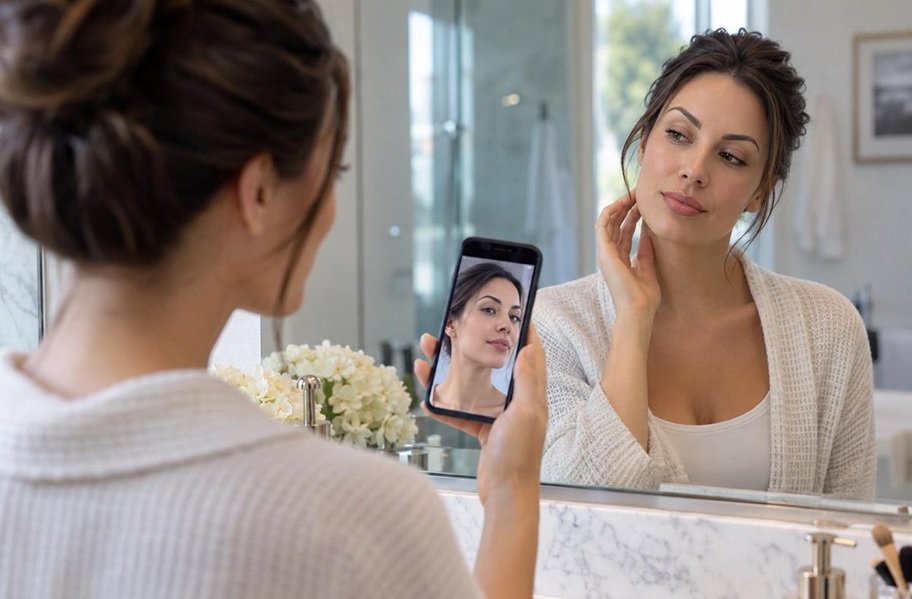
Results look different in photos than in the mirror for reasons that have nothing to do with surgery. The mirror shows a reversed face you have grown used to. Cameras add distortion based on distance and lens. Lighting, angle, expression, and phone processing shift the picture again. Standardized clinical photography exists to remove those variables so a change can be judged fairly.
You liked what you saw in the bathroom mirror. Then a friend sent a group photo, and for a second you did not recognize your own face. That gap is one of the most common things patients bring up after surgery, and it is the reason results look different in photos than in the mirror for almost everyone, treated or not. It is unsettling, and it is also completely explainable.
At The One Plastic Surgery Center in Newport Beach, board-certified plastic surgeon Dr. Siamak Agha spends part of nearly every consultation on this exact question. Patients arrive with a phone full of images: a selfie they hate, a filtered photo they love, and a mirror memory that matches neither. Sorting out which of those images is telling the truth matters, because it shapes what a person asks for and how they judge what they get. Here is what the science actually says.
Your Mirror Face and Your Camera Face Are Not the Same Face
Quick take: A mirror shows a left-right reversed version of you, and that reversed version is the one you have practiced recognizing your entire life. A photograph shows the face everyone else sees, which your brain has far less experience with.
Psychologists call the underlying effect mere exposure: the more often we see something, the more we tend to like it. Research on self-perceived beauty and the mirror effect describes how people generally prefer the mirror-reversed image of themselves, while friends and family who show the same pair prefer the true, unreversed one. Nobody is wrong. Each group simply prefers the version it knows.
This matters more because no face is symmetric. Flipping an image moves every small asymmetry to the opposite side, which reads as “off” without you being able to say why.
- One brow usually sits slightly higher than the other
- Smiles almost always pull a little harder on one side
- Most noses deviate a few degrees from the center
- Cheek fullness and jaw angle rarely match side to side
Why Results Look Different in Photos: Camera Distance and Focal Length
Quick take: The closer a camera is to your face, the more it exaggerates whatever is nearest the lens. At selfie range, that means the nose, and the distortion is measurable, not imagined.
Researchers at UT Southwestern measured the distortion directly and published the findings in Plastic and Reconstructive Surgery. Compared with a standard clinical photo taken at five feet, selfie photographs distorted facial proportions in a consistent way: the nose measured about 6.4 percent longer at twelve inches and about 4.3 percent longer at eighteen inches. Chin length shrank by roughly 12 percent in the closest images.
Combining those two shifts, the ratio of nose length to chin length rose about 17 percent. The nasal base also looked wider relative to the face. That is a meaningfully different nose, created by arm length alone.
- Bent elbow, roughly twelve inches: maximum distortion
- Arm’s length, roughly eighteen inches: less, but still present
- Five feet or more with a longer lens: close to true proportion
This information is worth knowing before any facial procedure, and especially before rhinoplasty in Newport Beach, where a few millimeters matter and the reference image a patient brings in shapes the whole conversation.
“At selfie range, the camera exaggerates the nose. That is physics, not your face.”
Lighting, Angle, and Expression Change What the Camera Records
Quick take: Light direction, camera height, and even how you hold your jaw can change apparent volume, shadowing, and symmetry in a single photo, without anything about the underlying anatomy changing at all.
Vision science backs this up. A study published in the Journal of Vision found that lighting direction biases how symmetrical a face appears, shifting viewers’ judgments toward the side the light comes from. Overhead light deepens the hollows under the eyes and the nasolabial folds. Flat, frontal light erases them.
Camera height does similar work. Shooting from below emphasizes the under-chin area and shortens the midface. Shooting from slightly above does the reverse. A small chin tuck can create fullness under the jaw that is not there when you stand normally, which is why neck and jawline concerns are so often exaggerated or hidden depending on the shot. Anyone comparing images before or after a facelift and neck lift in Newport Beach should hold those variables steady.
Phone Processing and Filters: Another Reason Results Look Different in Photos
Quick take: Modern phones do not simply record a face. They apply lens correction, skin smoothing, background blur, and tone mapping automatically, and many apps add reshaping on top of that.
The American Society of Plastic Surgeons has been direct about these issues. In its guidance on social media’s influence on plastic surgery decisions, surgeons note that even ordinary portrait mode flatters nearly everyone and that patients frequently cannot tell a filtered inspiration photo from an achievable outcome. Surgeons often can. Patients usually cannot.
- Front-facing lenses are wide angle, which stretches features near the frame edges
- Portrait mode blurs the background and softens skin texture
- Automatic tone mapping brightens shadows, flattening contour
- Beauty filters narrow jaws, enlarge eyes, and slim noses in real time
The practical fix is simple. Take reference photos with the rear camera, at arm’s length or farther, with all enhancement turned off.
Why Surgeons Use Standardized Clinical Photography
Quick take: Standardized photography fixes distance, lens, lighting, background, and pose so that the only thing allowed to change between two images is the patient. It is a measurement tool, not a marketing tool.
Published guidance in the Aesthetic Surgery Journal Open Forum on standardizing clinical photography in plastic surgery describes the elements: a camera on a tripod roughly 1.5 meters from the patient, a longer lens rather than a wide one, controlled studio lighting in a windowless room, and a plain light blue background that suits a range of skin tones.
The patient side is standardized too. Makeup and jewelry come off, hair goes back, consistent undergarments are worn, and each anatomic area has defined views and framing that are repeated exactly at follow-up. That discipline is what makes a documented facelift before and after gallery worth studying instead of simply admiring.
“Standardized photography changes one variable at a time. Everything else stays deliberately, usefully boring.”
How to Read a Before and After Gallery Critically
Quick take: A trustworthy set of images looks almost monotonous: same distance, same light, same pose, same background, same expression. Drama between the two frames usually comes from the setup, not the surgery.
ASPS offers a useful checklist for deciding whether a before and after is too good to be true, including scars that have vanished implausibly early and small physical impossibilities such as earrings hanging at odd angles. Its companion article on whether you can trust before and after photos adds the classic tell: arms down and unsmiling in the before, arms raised and beaming in the after.
- Check that lighting and background match across both frames
- Look for the same views repeated, not one flattering angle
- Note posture, clothing, makeup, and tan as separate variables
- Prefer galleries with many cases over a handful of highlights
- Look for patients whose starting anatomy resembles yours
Video content such as patient stories and video testimonials can help here, since motion is harder to stage than a still frame.
When Photo Comparisons Start Shaping How You Feel
Quick take: Repeated editing and comparison can shift self-perception in ways that outlast any single photo, which is why surgeons pay attention to the images a patient brings in and the feelings attached to them.
Research published in BMC Psychology found that photo editing on social media lowered self-esteem indirectly, working through self-objectification and appearance comparison rather than directly. Put plainly, the editing itself is less harmful than the habit of measuring yourself against the edited version.
That is a clinical concern, not a moral one. A goal defined by a filter is one no surgeon can truthfully meet, because the filter does not describe a human face. Bringing unfiltered images and describing concerns in words tends to produce a far more useful consultation.
Key Takeaways
- The mirror shows a reversed face your brain prefers through familiarity, while photos show the face others already know.
- Camera distance measurably distorts facial proportion, with the nose appearing longer and the chin shorter at selfie range.
- Lighting direction, camera height, expression, and phone processing each change the image without changing the anatomy.
- Standardized clinical photography controls distance, lens, light, background, and pose so a real change can be judged.
- Filtered reference images make goals harder to define, so bring unedited photos to a consultation.
Results and candidacy vary from patient to patient. Only an in-person consultation with a board-certified plastic surgeon can determine whether a given procedure is appropriate for you.
Seeing Yourself Accurately Before You Decide Anything
Photographs and mirrors are both partial accounts of the same face. Once you know which distortions belong to the lens, the light, and the software, both become far more useful and far less upsetting. That clarity is worth having before any decision about surgery, not after it.
Ready to find out what a procedure could realistically address for your anatomy? Schedule a consultation with board-certified plastic surgeon Dr. Siamak Agha at The One Plastic Surgery Center in Newport Beach to review your photographs, discuss your goals, and get an honest assessment of your options.
Frequently Asked Questions
Why does my nose look bigger in selfies?
This happens because the camera is close to your face, which exaggerates the size of closer objects. Measured research comparing selfies with standard clinical photos found the nose appeared roughly 6.4 percent longer at twelve inches and the chin about 12 percent shorter, which raised the nose-to-chin ratio by about 17 percent. Stepping back several feet removes most of that effect.
Which one is the real me, the mirror, or the photo?
The photograph is closer to what other people see, since a mirror reverses your face. Neither is perfectly accurate, because photographs still carry lens, lighting, and processing effects. A standardized clinical photograph taken at a fixed distance under controlled lighting is the most neutral version available.
Why do practices take their own photos instead of using mine?
Because personal photos vary in distance, lens, lighting, pose, and editing, they cannot be used for comparison. Standardized photography fixes those variables so that the only difference between a preoperative and postoperative image is the patient. This is how we measure surgical change instead of guessing.
Can I bring inspiration photos to a consultation?
Yes, and they are useful for showing aesthetic preference. Just bring unfiltered images and understand that another person’s anatomy cannot be transferred to yours. Your surgeon will discuss which elements are realistic given your bone structure, skin quality, and tissue thickness.
How should I take my own progress photos after surgery?
Use the rear camera, stand at least five feet away, and turn off filters, beauty modes, and heavy editing. Use the same room, same light source, same time of day, same distance, and same neutral expression each time. Consistency matters far more than image quality.